

Modern call centers and Business Process Outsourcers (BPOs) increasingly rely on video for customer service. Agents often work from home or in dense hubs using thin clients and virtualized desktops (DaaS & VDI). In these environments, video calls could expose distracting backgrounds and reduce perceived trust. A solution would require applying professional branding to all company agents’ screen backgrounds and allowing central management by the IT team without increasing server-side costs. However, integrating these solutions into DaaS & VDI environments poses a significant technical challenge due to the complexities of real-time video redirection and resource constraints.
Conceptual Design
Edge-AI background removal redirection
Policy-enforced background standardization via client-side offloading
A background-standardization layer would be integrated into the thin client via a dedicated redirection module. This component would intercept the local webcam feed and apply AI segmentation at the edge before the video enters the remote session. Using standard Virtual Channels (RDP or Citrix), the processed, branded stream would be redirected to the VDI server, as with any other standard virtual camera, thereby allowing its use in applications such as Microsoft Teams, Zoom, or Google Meet, and enabling centralized configuration on the server. This architecture would also ensure that the heavy AI processing is offloaded to the client hardware, maintaining high performance without increasing server-side compute costs.
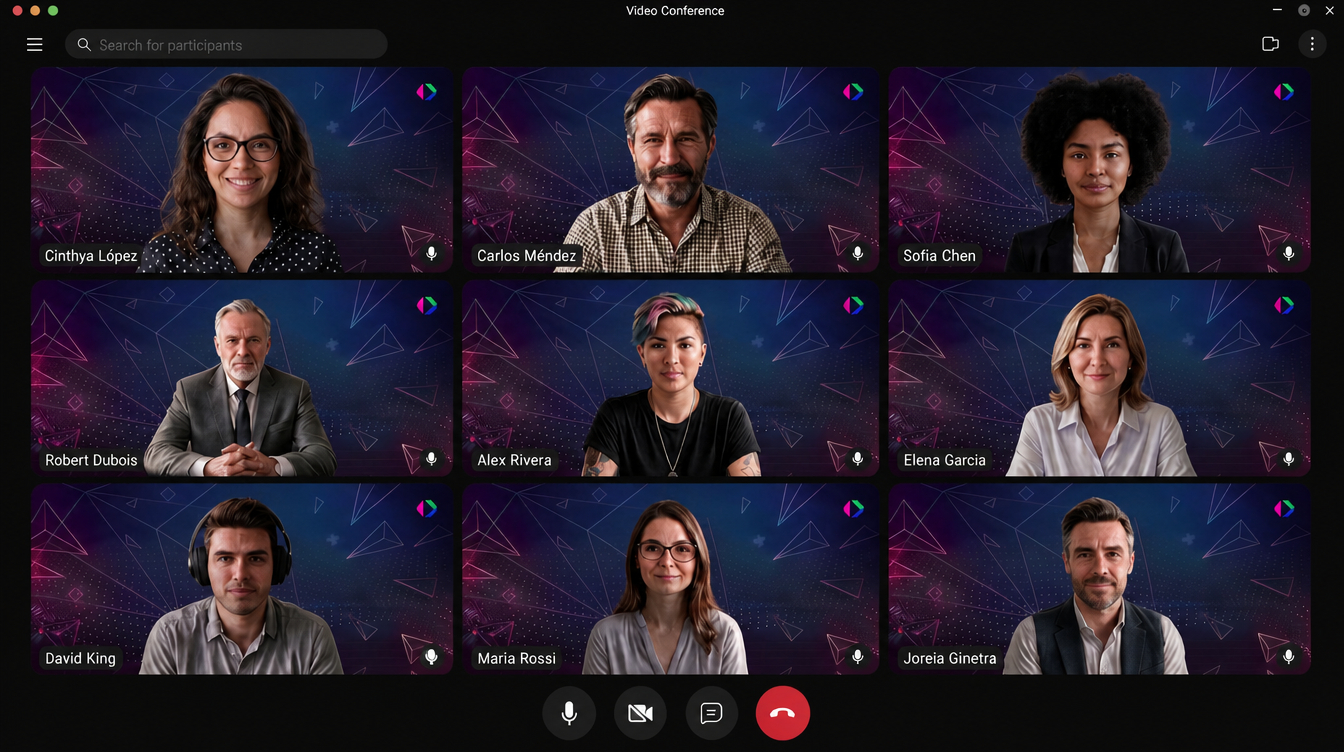
Edge-AI background removal redirection
Policy-enforced background standardization via client-side offloading
A background-standardization layer would be integrated into the thin client via a dedicated redirection module. This component would intercept the local webcam feed and apply AI segmentation at the edge before the video enters the remote session. Using standard Virtual Channels (RDP or Citrix), the processed, branded stream would be redirected to the VDI server, as with any other standard virtual camera, thereby allowing its use in applications such as Microsoft Teams, Zoom, or Google Meet, and enabling centralized configuration on the server. This architecture would also ensure that the heavy AI processing is offloaded to the client hardware, maintaining high performance without increasing server-side compute costs.
The value we deliver: How we boost your business

Reputational assurance
The solution would enhance the organization’s reputation by ensuring a uniform, professional appearance across all video interactions, regardless of the agent’s setting.

Risk reduction
It would protect the business against incidents, privacy breaches, or brand damage during live customer calls.

Integration
The solution integrates as a standard virtual camera redirected to the remote server. This would allow conferencing applications such as Microsoft Teams, Zoom, or Webex to recognize the feed as a native webcam device and enable policy-enforced, centralized configuration on the server.

Scalability
Offloading heavy AI processing to client hardware would allow the solution to scale across diverse, low-cost endpoints without performance degradation or increased server-side compute costs.
Reputational assurance
The solution would enhance the organization’s reputation by ensuring a uniform, professional appearance across all video interactions, regardless of the agent’s setting.
Risk reduction
It would protect the business against incidents, privacy breaches, or brand damage during live customer calls.
Integration
The solution integrates as a standard virtual camera redirected to the remote server. This would allow conferencing applications such as Microsoft Teams, Zoom, or Webex to recognize the feed as a native webcam device and enable policy-enforced, centralized configuration on the server.
Scalability
Offloading heavy AI processing to client hardware would allow the solution to scale across diverse, low-cost endpoints without performance degradation or increased server-side compute costs.