

DaaS & VDI providers need to deliver responsive, high-quality desktop sessions across different network conditions while keeping bandwidth and infrastructure costs under control. This is especially challenging for desktop content, where text, icons, windows, application interfaces, sharp edges, and flat color areas behave differently from camera-captured video.
Traditional video codecs are often optimized for natural video, which can make them less efficient when encoding screen content. As a result, providers may need to use higher bitrates to preserve text readability, UI sharpness, and visual consistency, increasing transmission costs and potentially degrading the user experience in constrained network environments.
This innovation project explores whether Screen Content Coding tools can improve the efficiency and quality of remote desktop streaming. The working hypothesis is that SCC techniques can better represent desktop-specific visual patterns and therefore help DaaS & VDI platforms deliver clearer screen content at lower bandwidth and with acceptable encoding complexity. The prototype direction is aligned with exploring SCC integration into a DaaS/VDI-specific codec to evaluate quality and encoding efficiency.
Conceptual Design
Designing a desktop-aware encoding optimization layer
A codec-agnostic approach to Screen Content Optimization
The proposed solution will explore integrating Screen Content Coding tools into Fluendo’s Remote Desktop Coding Tools technology stack. The objective is to evaluate how SCC techniques can improve the compression of desktop-oriented visual content, particularly in text-heavy interfaces, office applications, development environments, dashboards, browser sessions, and enterprise software.
The prototype could use a modern codec-experimentation framework to isolate SCC behavior and assess its impact on quality, bitrate, and encoding complexity. Rather than positioning a specific codec as the final product architecture, the innovation project should validate whether SCC concepts can be incorporated into a broader, codec-agnostic optimization toolkit for remote desktop streaming.
The solution may also consider desktop-specific signals from the operating system or remote desktop environment, such as changes to screen regions, window boundaries, application type, or areas with text and graphics. These signals could help the encoder make better decisions without relying only on generic video analysis.
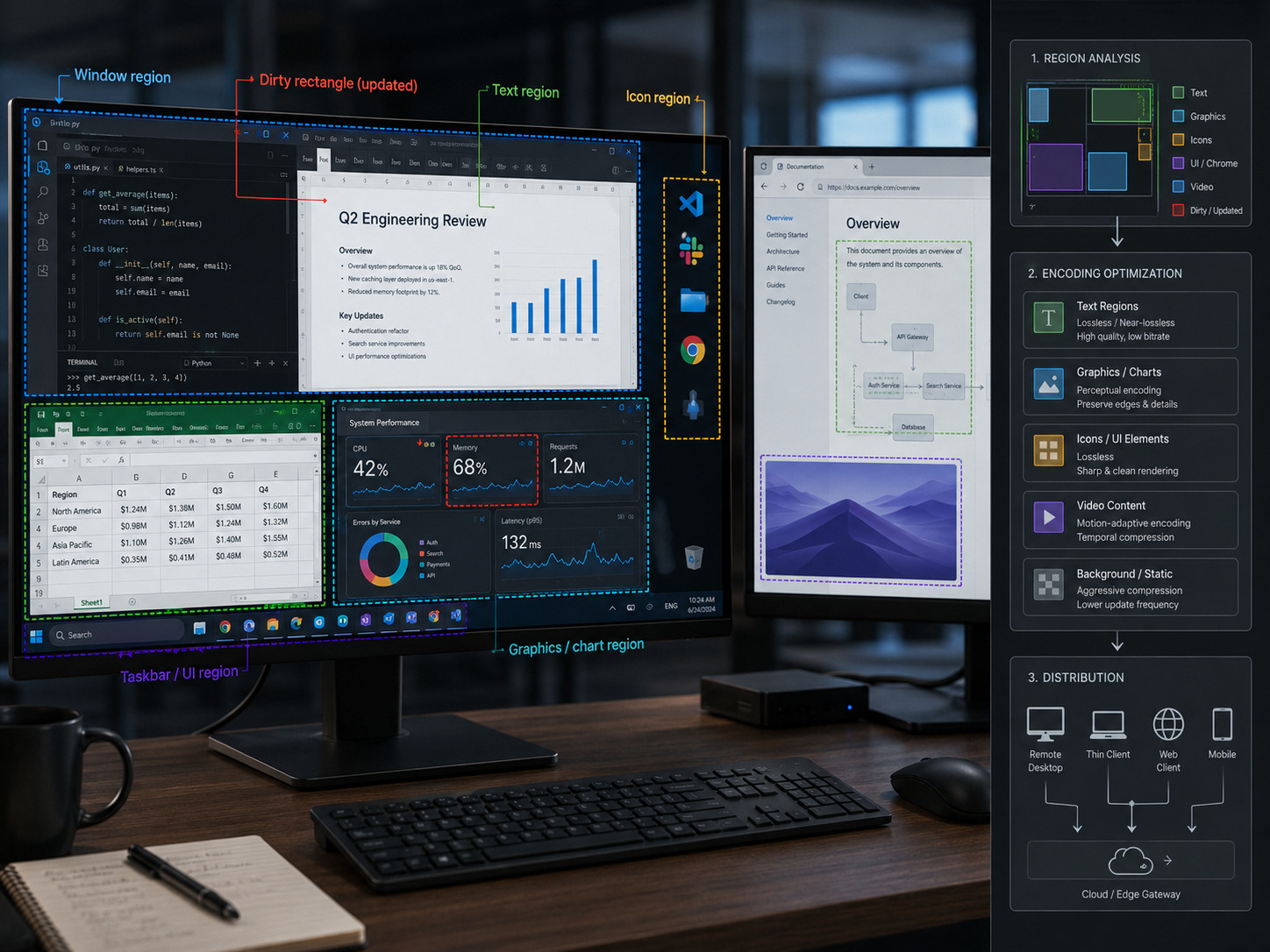
Designing a desktop-aware encoding optimization layer
A codec-agnostic approach to Screen Content Optimization
The proposed solution will explore integrating Screen Content Coding tools into Fluendo’s Remote Desktop Coding Tools technology stack. The objective is to evaluate how SCC techniques can improve the compression of desktop-oriented visual content, particularly in text-heavy interfaces, office applications, development environments, dashboards, browser sessions, and enterprise software.
The prototype could use a modern codec-experimentation framework to isolate SCC behavior and assess its impact on quality, bitrate, and encoding complexity. Rather than positioning a specific codec as the final product architecture, the innovation project should validate whether SCC concepts can be incorporated into a broader, codec-agnostic optimization toolkit for remote desktop streaming.
The solution may also consider desktop-specific signals from the operating system or remote desktop environment, such as changes to screen regions, window boundaries, application type, or areas with text and graphics. These signals could help the encoder make better decisions without relying only on generic video analysis.
The value we deliver: How we boost your business

Cost reduction
By improving compression efficiency for desktop content, SCC would help DaaS & VDI providers reduce bandwidth consumption while maintaining a high-quality visual experience.

Product quality
SCC would improve the perceived quality of remote desktop sessions by preserving text readability, sharp UI elements, graphics, and color consistency more effectively than generic video coding approaches.

Scalability
More efficient desktop encoding would help providers support larger deployments, more concurrent sessions, or higher-resolution desktop experiences without a proportional increase in infrastructure load.

Integration
Developed as part of the codec-agnostic RDCT toolkit, SCC would be easier to integrate across different codecs, streaming protocols, and customer environments, reducing adoption friction.
Cost reduction
By improving compression efficiency for desktop content, SCC would help DaaS & VDI providers reduce bandwidth consumption while maintaining a high-quality visual experience.
Product quality
SCC would improve the perceived quality of remote desktop sessions by preserving text readability, sharp UI elements, graphics, and color consistency more effectively than generic video coding approaches.
Scalability
More efficient desktop encoding would help providers support larger deployments, more concurrent sessions, or higher-resolution desktop experiences without a proportional increase in infrastructure load.
Integration
Developed as part of the codec-agnostic RDCT toolkit, SCC would be easier to integrate across different codecs, streaming protocols, and customer environments, reducing adoption friction.