

DaaS & VDI administrators currently lack a reliable, non-intrusive way to measure real-time video quality perceived by users. Traditional reference-based metrics (e.g., VMAF, PSNR, SSIM) require an original source stream that is unavailable in most production desktops, making live monitoring impractical.
Subjective methods (e.g., MOS following ITU BT.500/P.910) are costly, offline, and cannot operate continuously. Meanwhile, transport-level metrics (latency, loss, jitter, bitrate) do not consistently correlate with users’ visual experience, so degradations are detected late, after productivity and satisfaction have already dropped.
An approach that estimates perceived quality without a reference and runs continuously inside real environments would close this gap.
Conceptual Design
Reference-free AI model for continuous user-perceived quality estimation
An AI model predicts reference-free video quality metrics (VMAF-like) directly from live desktop/video streams, enabling continuous QoS visibility and proactive anomaly detection.
The capability would be provided as a modular software library and a Fluendo AI GStreamer plugin using Raven AI Engine for inference, so that it could be embedded at the endpoint, broker, or server, and exported to existing observability stacks
The model would be trained to correlate strongly with human judgments and well-known objective metrics (such as VMAF), and validated across common DaaS workloads (text editors, spreadsheets, 3D tools, conferencing) to remain content-aware and low-overhead for real-time operation.
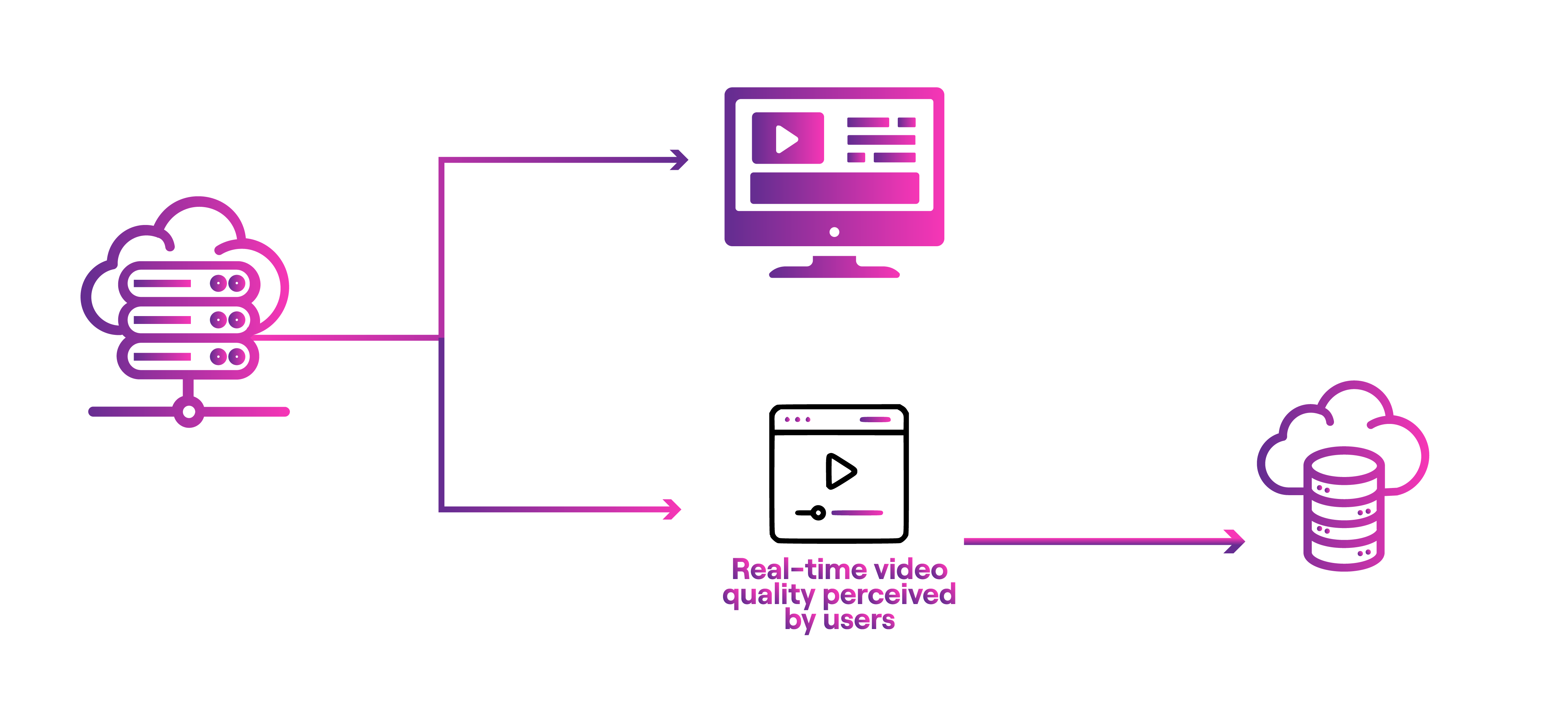
Reference-free AI model for continuous user-perceived quality estimation
An AI model predicts reference-free video quality metrics (VMAF-like) directly from live desktop/video streams, enabling continuous QoS visibility and proactive anomaly detection.
The capability would be provided as a modular software library and a Fluendo AI GStreamer plugin using Raven AI Engine for inference, so that it could be embedded at the endpoint, broker, or server, and exported to existing observability stacks
The model would be trained to correlate strongly with human judgments and well-known objective metrics (such as VMAF), and validated across common DaaS workloads (text editors, spreadsheets, 3D tools, conferencing) to remain content-aware and low-overhead for real-time operation.
The value we deliver: How we boost your business

Information
Provides actionable data on service performance and user experience

Transparency
Offers a clear view into service health and potential bottlenecks

Product Quality
Ensures consistent high-quality service delivery

Risk Reduction
Proactively identifies and mitigates service degradation
Information
Provides actionable data on service performance and user experience
Transparency
Offers a clear view into service health and potential bottlenecks
Product Quality
Ensures consistent high-quality service delivery
Risk Reduction
Proactively identifies and mitigates service degradation