
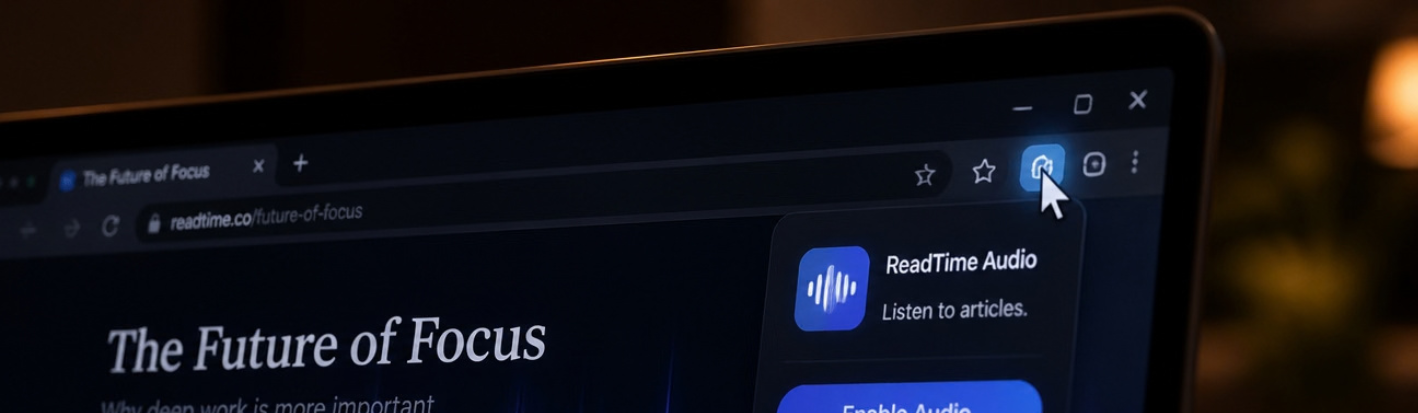
Web-based content consumption is growing rapidly, yet natural-sounding, browser-native text-to-speech remains largely unavailable for minority and co-official languages such as Catalan, Basque, Galician, and other European languages. News outlets, educational publishers, government portals, and cultural institutions need to make their digital content audible and accessible to all users, but existing TTS engines either lack support for these languages or produce robotic output that fails to engage listeners.
The EU Accessibility Act (effective June 2025) requires digital products and services to be perceivable and operable by people with disabilities, while WCAG 2.1 AA mandates that non-text content provides equivalent text alternatives and that content can be presented in different ways (including auditory) without losing meaning. Regional mandates such as Catalonia’s Llei de Política Lingüística add a further layer by requiring public-facing digital services to operate in co-official languages. Together, these frameworks create a compliance gap that most current TTS solutions cannot fill.
A browser-native AI text-to-speech solution would close that gap by enabling organizations to meet accessibility and language obligations simultaneously, while having a relevant social impact and helping digital publishers expand their audience reach.
Conceptual Design
How a browser-native AI text-to-speech reader works
From static text to expressive, real-time audio
The solution would consist of a web browser extension that captures page text and sends it to an inference API powered by next-generation TTS models fine-tuned for minority languages. The engine would apply prosody control to generate natural intonation, and pacing matched to the content type: news, education, or government, returning high-fidelity audio in real time.
It would use prosody-controllable AI text-to-speech to deliver natural, expressive voice synthesis directly in the browser and AI infrastructure to build a system without compromising on quality, safety, or compliance.
How a browser-native AI text-to-speech reader works
From static text to expressive, real-time audio
The solution would consist of a web browser extension that captures page text and sends it to an inference API powered by next-generation TTS models fine-tuned for minority languages. The engine would apply prosody control to generate natural intonation, and pacing matched to the content type: news, education, or government, returning high-fidelity audio in real time.
It would use prosody-controllable AI text-to-speech to deliver natural, expressive voice synthesis directly in the browser and AI infrastructure to build a system without compromising on quality, safety, or compliance.
Key technical differentiators
- Prosody-controllable synthesis: Would modulate rhythm, emphasis, and emotion for engaging, human-like narration adapted to each content category.
- Minority language specialization: Fine-tuned models would deliver accurate pronunciation and natural cadence for Catalan and other minority European languages, with phoneme error rates below 1%.
- Browser-native deployment: Would run as a lightweight web component compatible with major browsers on desktop and mobile. No installation would be needed.
- C2PA provenance integration: Cryptographic watermarking would ensure content authenticity, aligned with emerging AI-generated media transparency standards.
- EU AI Act compliance: Would provide full experiment traceability, consent-linked voice-actor IP management, and sovereign EU infrastructure from day one.
Key technical differentiators
- Prosody-controllable synthesis: Would modulate rhythm, emphasis, and emotion for engaging, human-like narration adapted to each content category.
- Minority language specialization: Fine-tuned models would deliver accurate pronunciation and natural cadence for Catalan and other minority European languages, with phoneme error rates below 1%.
- Browser-native deployment: Would run as a lightweight web component compatible with major browsers on desktop and mobile. No installation would be needed.
- C2PA provenance integration: Cryptographic watermarking would ensure content authenticity, aligned with emerging AI-generated media transparency standards.
- EU AI Act compliance: Would provide full experiment traceability, consent-linked voice-actor IP management, and sovereign EU infrastructure from day one.
The value we deliver: How we boost your business

Enhances accessibility for all users, including those with visual impairments

Product Quality
Provides natural, high-quality synthetic voices

Innovation
Implements real-time, AI-driven TTS directly in the browser

Regulatory Compliance
Implements real-time, AI-driven TTS directly in the browser
Enhances accessibility for all users, including those with visual impairments
Product Quality
Provides natural, high-quality synthetic voices
Innovation
Implements real-time, AI-driven TTS directly in the browser
Regulatory Compliance
Implements real-time, AI-driven TTS directly in the browser