
Use Cases
Intelligent occupancy and flow analytics from existing camera infrastructure
In high-traffic environments such as retail stores, transportation hubs, entertainment venues, and smart buildings, understanding real-time occupancy and pedestrian flow is critical for safety compliance, operational efficiency, and business intelligence. However, traditional methods, manual counting, turnstile-based systems, or basic sensor arrays tend to be costly, inaccurate, and unable to provide the spatial flow insights needed for informed decision-making.
A growing need exists for automated, camera-based solutions that deliver accurate occupancy counts, directional flow analysis, and zone-level breakdowns, all in real-time, without requiring personal identification, and in compliance with privacy regulations such as GDPR. With today’s advances in computer vision and AI, it would be possible to deploy intelligent video analytics systems that transform existing surveillance infrastructure into a powerful source of actionable data, processed entirely at the edge.
Conceptual Design
How would people be counted and flow be analyzed automatically?
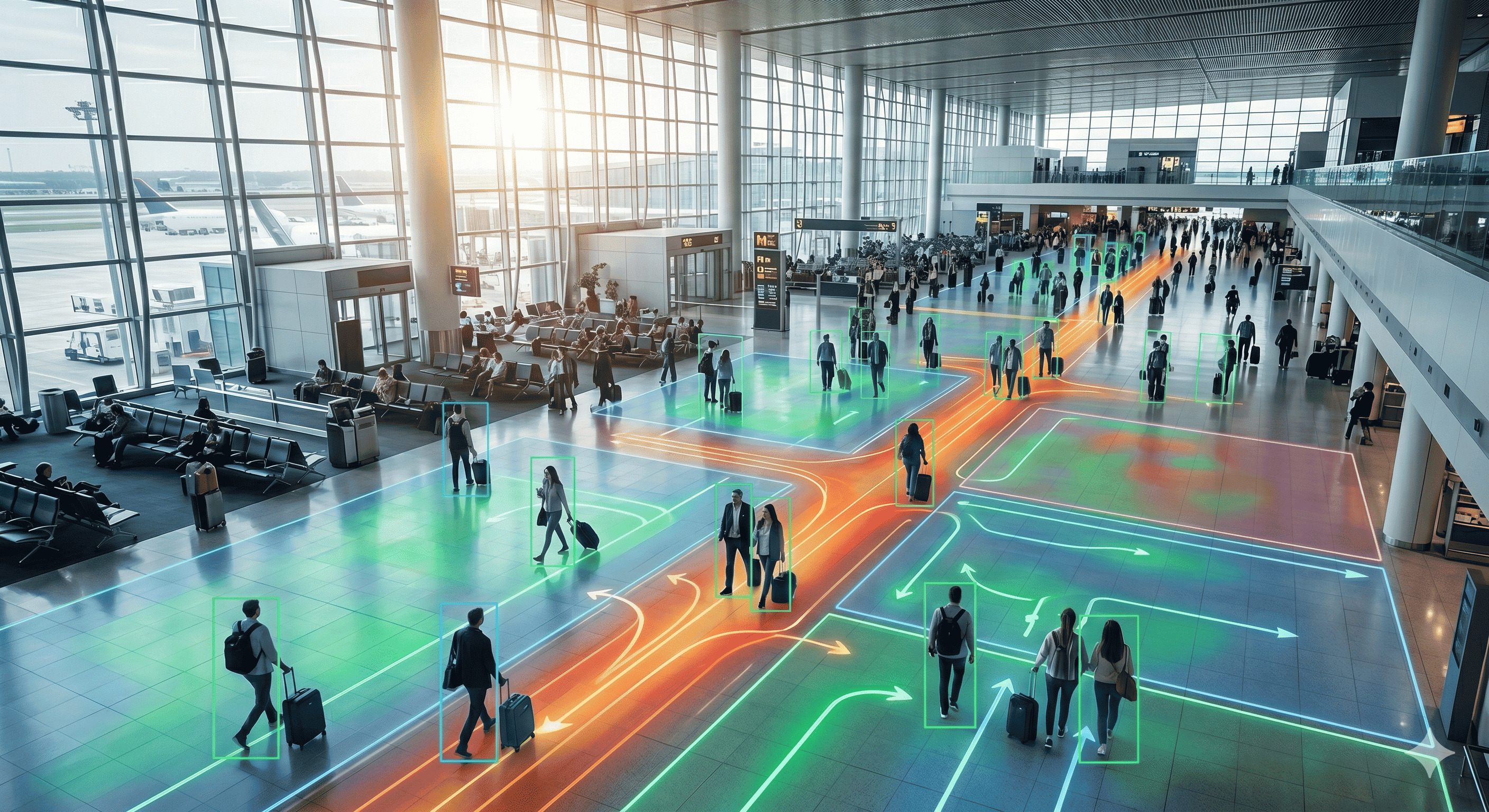
A people-counting and flow-analysis application would use deep learning–based detection and multi-object tracking models to identify and track individuals across video frames in real-time. With virtual lines and zones defined in the camera’s field of view, the system would count entries, exits, and crossings per area, while tracking movement direction and dwell time.
The solution would be built as a modular GStreamer pipeline using Fluendo AI Plugins and the AI Engine:
People Detection — A real-time object detection model would identify people in each frame, even in crowded or partially occluded scenes, running inference directly on the GPU through Raven’s fully hardware-accelerated pipeline.
Multi-Object Tracking — Detected individuals would be assigned persistent IDs and tracked across consecutive frames using the tracking module, enriched with deep learning–based re-identification capabilities.
Flow & Direction Analysis — The system would calculate the direction of movement for each tracked individual using trailing metadata, enabling directional flow maps, heatmaps, and dwell-time analytics.
This pipeline would integrate seamlessly with standard CCTV and IP camera streams and could be optimized for edge computing deployment through the AI Engine, enabling real-time processing on local hardware without cloud dependency. Full hardware acceleration across Intel, AMD, and NVIDIA GPUs would ensure efficient performance even in resource-constrained environments.
How would people be counted and flow be analyzed automatically?
A people-counting and flow-analysis application would use deep learning–based detection and multi-object tracking models to identify and track individuals across video frames in real-time. With virtual lines and zones defined in the camera’s field of view, the system would count entries, exits, and crossings per area, while tracking movement direction and dwell time.
The solution would be built as a modular GStreamer pipeline using Fluendo AI Plugins and the AI Engine:
People Detection — A real-time object detection model would identify people in each frame, even in crowded or partially occluded scenes, running inference directly on the GPU through Raven’s fully hardware-accelerated pipeline.
Multi-Object Tracking — Detected individuals would be assigned persistent IDs and tracked across consecutive frames using the tracking module, enriched with deep learning–based re-identification capabilities.
Flow & Direction Analysis — The system would calculate the direction of movement for each tracked individual using trailing metadata, enabling directional flow maps, heatmaps, and dwell-time analytics.
This pipeline would integrate seamlessly with standard CCTV and IP camera streams and could be optimized for edge computing deployment through the AI Engine, enabling real-time processing on local hardware without cloud dependency. Full hardware acceleration across Intel, AMD, and NVIDIA GPUs would ensure efficient performance even in resource-constrained environments.
The value we deliver: How we boost your business

Information
Generates insights into space usage and movement patterns

Cost Reduction
Utilizes existing camera infrastructure to avoid new hardware costs

Product Quality
Delivers intelligent, data-driven analytics

Scalability
Easily expands across large camera networks
Information
Generates insights into space usage and movement patterns
Cost Reduction
Utilizes existing camera infrastructure to avoid new hardware costs
Product Quality
Delivers intelligent, data-driven analytics
Scalability
Easily expands across large camera networks