




Fluendo awarded 6G-XR Open Call 3 grant to pioneer LCEVC-Powered holographic streaming
daas-vdi, gstreamer, codecs, lynxFluendo selected for 6G-XR grant to pioneer holographic streaming with LCEVC.
A specialized, cost-effective, and energy-efficient encoding solution leveraging LCEVC-based enhancement layer, screen content coding (SCC) tools, content-aware encoding optimization, guided encoder search, and chroma upsampling to a enhanced EUC (End User Computing) UX (User Experience).


The end user computing industry (remote desktop and application, DaaS/VDI providers, thin clients, and endpoint OSes) requires robust solutions that maintain high-quality visual experiences in bandwidth-constrained environments.
General-purpose codecs frequently underperform in these specialized scenarios, leading to higher operational costs and energy consumption.
To address this, Fluendo is expanding its Thin Client (TC) division by introducing Lynx. Strategically positioned to reduce Total Cost of Ownership (TCO), Lynx provides a highly efficient, greener solution that increases profitability for providers while delivering a smooth, optimized End User Computing (EUC) experience.
The end user computing industry (remote desktop and application, DaaS/VDI providers, thin clients, and endpoint OSes) requires robust solutions that maintain high-quality visual experiences in bandwidth-constrained environments.
General-purpose codecs frequently underperform in these specialized scenarios, leading to higher operational costs and energy consumption.
To address this, Fluendo is expanding its Thin Client (TC) division by introducing Lynx. Strategically positioned to reduce Total Cost of Ownership (TCO), Lynx provides a highly efficient, greener solution that increases profitability for providers while delivering a smooth, optimized End User Computing (EUC) experience.
This research line focuses on engineering a specialized codec (encoder and decoder) explicitly designed for the unique demands of desktop remoting.
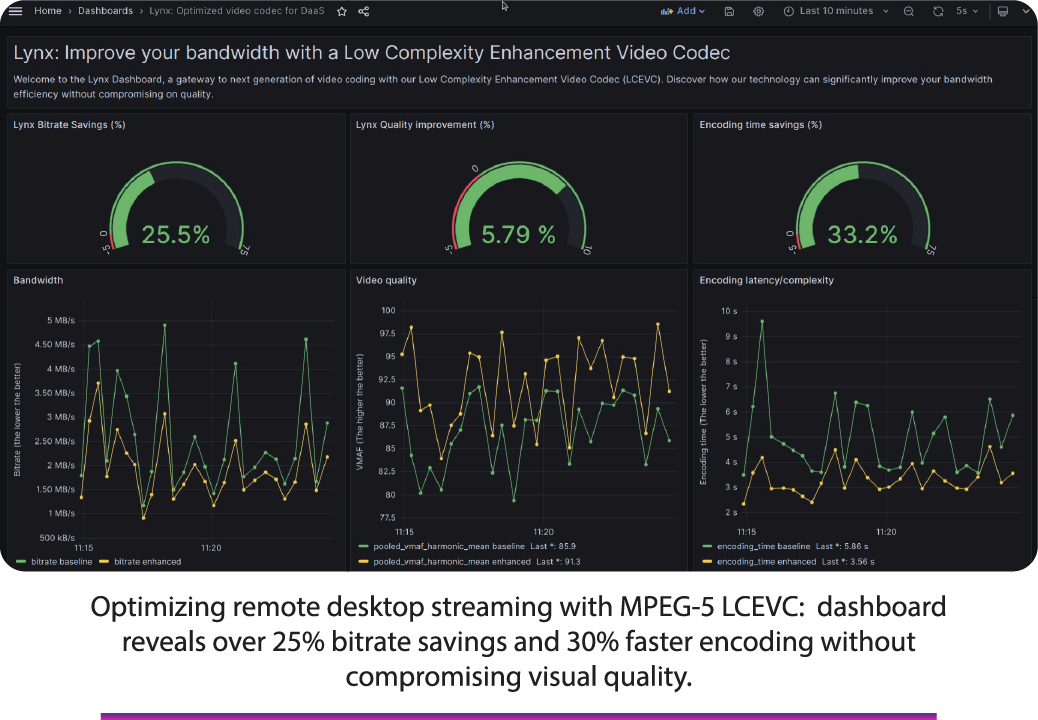
The project leverages an LCEVC enhancement layer to boost the compression efficiency of any base codec. Beyond this foundation, we have developed and integrated several advanced technological prototypes to maximize performance. This includes screen content coding (SCC) tools optimized for text and sharp UI graphics, alongside content-aware encoding optimization and guided encoder search to dynamically reduce computational overhead. Furthermore, LCEVC-based chroma upsampling ensures true color fidelity, resulting in a pixel-perfect visual experience. Together, these elements enable tailored tuning presets specifically optimized for the rigorous demands of DaaS/VDI environments.
A major development focus is a dedicated, backward-compatible API tailored for DaaS and VDI use cases. This allows clients to achieve operational efficiency and integrate the technology into their existing infrastructure without disruptive hardware or protocol upgrades.

A specialized video codec for desktop remoting with reduced operational costs and improved user experience while remaining backward compatible with existing codecs and infrastructure.
our use cases
These use cases present conceptual examples of how our ideas and technologies could address real-world industry challenges.

DaaS & VDI platforms must continually optimize for performance, scalability, and user experience. These platforms face increasing challenges due to high-resolution content delivery, fluctuating network conditions, and the growing demand for cost-effective scalability.
Standard video codecs often present trade-offs between visual fidelity and bandwidth consumption or processing load. These trade-offs become more pronounced at scale, directly affecting infrastructure costs, session density, and quality of service. Remote Desktop Coding Tools (RDCT), a hybrid solution based on H.264 enhanced with MPEG-5 LCEVC and desktop domain coding optimizations (including desktop content entropy tuning, region-of-interest coding, and improved color management), would offer a flexible and integrable response to these challenges.
The use of RDCT across the DaaS and VDI value chain would enable vendors and integrators to meet enterprise demands for performance, reliability, and cost-efficiency without requiring significant infrastructure overhauls.

In modern DaaS & VDI infrastructures, maintaining visual accuracy is essential for professionals working with 2D and 3D design, photo and video editing, medical image analysis, and other color-sensitive applications. These workflows demand precise color reproduction, smooth gradients, and razor-sharp detail, attributes that directly impact perception, precision, and decision-making.
However, most remote desktop solutions still rely on YUV 4:2:0 chroma subsampling, which reduces color data by up to 75% to save bandwidth. While efficient, this approach introduces color bleeding and soft edges, making it harder to distinguish subtle tones and fine details, especially in text-heavy or design-centric use cases.
Delivering true 4:4:4 fidelity, where every pixel and color component is transmitted, typically increases data volume by 1.5× to 2× compared to standard 4:2:0 streams. Some “lossless” or dual-encoder implementations can even require up to 40× more bandwidth and dedicated GPU acceleration, severely limiting scalability in real-world enterprise or cloud environments.

Video encoders used in DaaS & VDI, even those with advanced Screen Content Coding (SCC) tools, must rely on computationally expensive intra- and inter-frame analysis of the video stream to understand the content’s complexity and motion, which consumes a significant amount of server-side CPU/GPU resources. This process is fundamentally inefficient for remote desktops because the encoder is working to deduce information that the virtualized operating system already knows intrinsically. This redundancy creates a direct and costly trade-off between visual quality and server density.
Bits & Bytes
Explore our blog, one byte at a time. Our team unpack our latest news, industry insights and in-depth articles to connect you with the multimedia world.Fluendo selected for 6G-XR grant to pioneer holographic streaming with LCEVC.
Fluendo selected for SPIRIT grant to develop AI-powered avatar telepresence.
Enhancing FreeRDP performance with MPEG-5 LCEVC for DaaS and VDI.
Optimizing DaaS/VDI performance with LCEVC and x264.