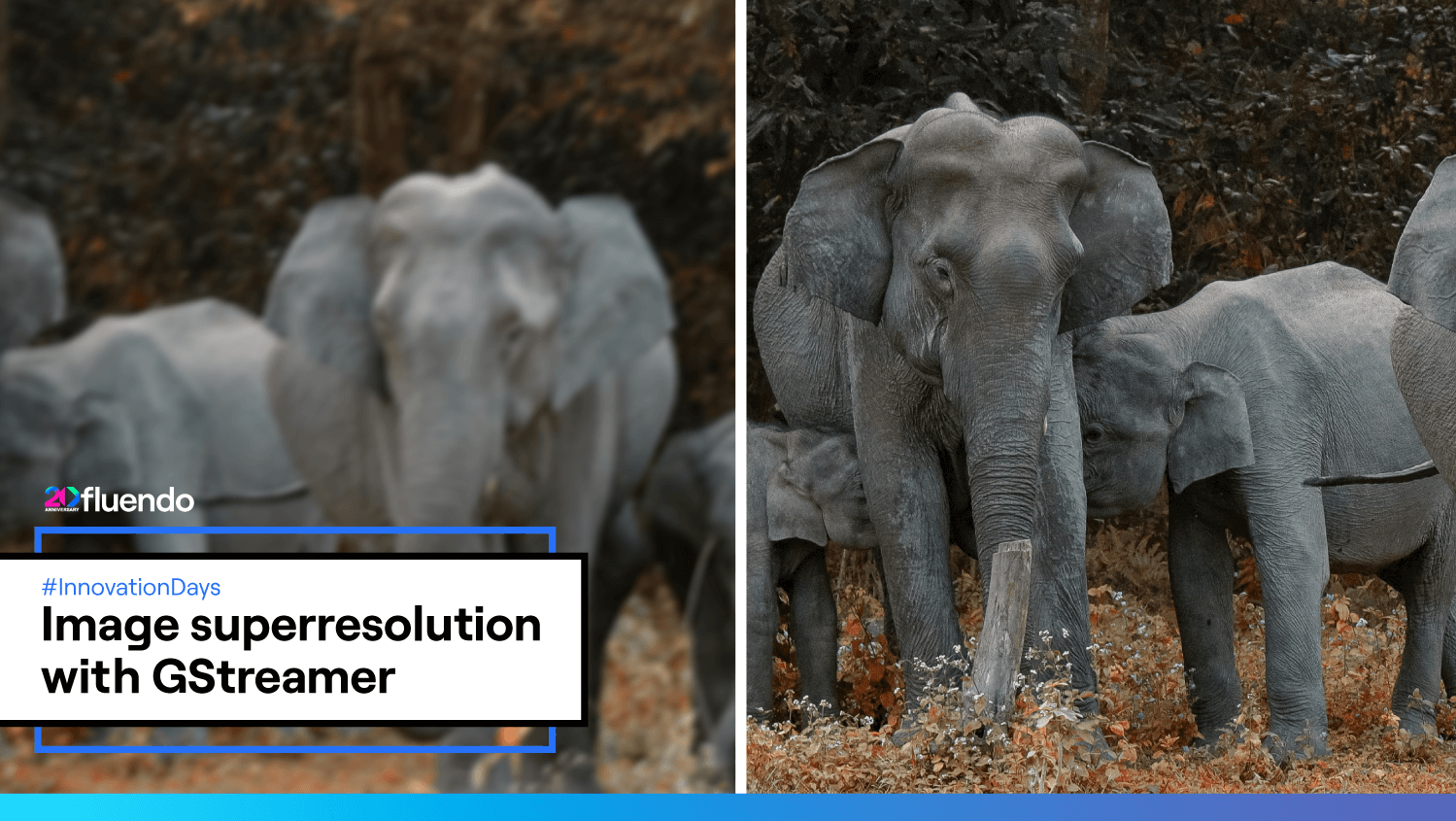
Image superresolution with GStreamer
broadcasting, video-surveillance, sports, multimedia-edge-ai, gstreamer, events, fluendo-ai-plugins, ravenAI-powered 4x video upscaling with Fluendo's GStreamer plugin.

With over ten years of experience developing sports video analysis software, we enable organizations to ingest, analyze, and visualize tactical data at scale. Our solutions transform raw match footage into structured, actionable performance metrics without manual tagging overhead.

Use the latest technologies and state-of-the-art machine learning algorithms to extract the most valuable information through advanced sport video analysis.
Streamline your workflow by automating tasks that require countless hours of manual effort. Optimize your process with robust sports performance analysis software, save time, and focus on what matters most: making data-driven decisions that drive results.
Use the latest technologies and state-of-the-art machine learning algorithms to extract the most valuable information through advanced sport video analysis.
Streamline your workflow by automating tasks that require countless hours of manual effort. Optimize your process with robust sports performance analysis software, save time, and focus on what matters most: making data-driven decisions that drive results.
Take full advantage of our Multimedia Edge AI tools and products designed to transform your company’s sports video analysis and decision-making processes.
Take powerful insights with precise sport video analysis, leveraging AI-powered vision technology.
Seamlessly edit and process videos with efficiency and flexibility.
Improve your reliability by having proper validation systems that can emulate your video analysis software for sports as a whole with long-running and regression tests.
Our solutions are tailored for multiple sports, utilizing customized models and algorithms for each discipline to extract accurate, sport-specific data and actionable insights.
Take powerful insights with precise sport video analysis, leveraging AI-powered vision technology.
Seamlessly edit and process videos with efficiency and flexibility.
Improve your reliability by having proper validation systems that can emulate your video analysis software for sports as a whole with long-running and regression tests.
Our solutions are tailored for multiple sports, utilizing customized models and algorithms for each discipline to extract accurate, sport-specific data and actionable insights.
our use cases
These use cases present conceptual examples of how our ideas and technologies could address real-world industry challenges.

Historic sports footage represents a valuable asset for broadcasters, clubs, sports federations, and media archives. However, many classic matches were recorded in low resolutions, analog formats, or early digital standards, resulting in blurry visuals, limited detail, and reduced viewing quality on modern displays.
Manually restoring and enhancing these recordings is complex, time-consuming, and often requires specialized post-production workflows. As demand grows for remastered sports content, documentaries, digital archives, and modern streaming platforms, improving the quality of historic footage has become increasingly important.
With advancements in AI-based superresolution, computer vision models can reconstruct missing details and upscale legacy sports videos to higher resolutions. By processing video frames automatically, such systems can transform historic recordings into clearer, sharper versions suitable for modern screens while preserving the authenticity of the original footage.
Historic sports footage can be enhanced using deep learning superresolution models that reconstruct high-frequency details from low-resolution recordings. By analyzing spatial patterns in each frame, these models generate sharper textures, clearer player silhouettes, and more defined field lines, significantly improving the visual quality of archived matches.
This capability can be integrated into video processing pipelines using the superresolution component of Fluendo AI Plugins (FAIP), built on top of Fluendo’s AI infrastructure. The component processes video frames and produces upscaled outputs (e.g., ×3 or ×4 resolution), enabling sports organizations to restore legacy footage and adapt it for modern displays and distribution platforms.
This superresolution solution is designed for seamless integration and works with standard video files, live streams, or broadcast archives using a GStreamer pipeline.

Restores and improves the quality of legacy sports footage

Uses AI to upscale and clean historic archives

Enhances historic matches with greater visual clarity, enabling clubs, broadcasters, and media companies to create engaging documentaries, highlights, and digital experiences.

Applies specialized media restoration knowledge to sports history
Restores and improves the quality of legacy sports footage
Uses AI to upscale and clean historic archives
Enhances historic matches with greater visual clarity, enabling clubs, broadcasters, and media companies to create engaging documentaries, highlights, and digital experiences.
Applies specialized media restoration knowledge to sports history

Youth and academy sports organizations increasingly record matches and training sessions for performance analysis, coaching review, and player development. However, these recordings often include minors, spectators, and staff members, creating important privacy and regulatory challenges, particularly under frameworks such as GDPR and child protection policies.
Manually anonymizing individuals in sports footage is time-consuming and difficult to scale, especially when clubs, academies, or federations manage large volumes of recorded matches, training sessions, and archived content.
With advances in AI-based person detection, tracking, and segmentation, computer vision systems can automatically detect individuals appearing in sports video and apply anonymization techniques such as face blurring or body masking. At the same time, the system can preserve useful movement and positional metadata, enabling coaches and analysts to study gameplay, tactics, and player behavior without exposing personal identities.
Our solution uses deep learning models to detect and segment individuals appearing in sports video recordings. This includes not only players on the field, but also coaches, referees, staff members, and spectators who may appear in the footage. Once detected, the system applies privacy-preserving transformations such as face blurring, pixelation, or full-body masking to ensure that individuals cannot be identified.
Video streams are processed through an AI pipeline integrated directly into the sports video workflow. The system analyzes each frame to identify people present in the scene and automatically applies anonymization techniques while preserving the overall visual context of the match or training session.
In addition to anonymization, the system can extract structured metadata describing the scene, such as the presence and positioning of individuals on the field or in surrounding areas. This allows sports organizations to maintain useful analytical capabilities for coaching review, performance analysis, or content management, while ensuring that the identities of players, staff, and spectators remain protected.
By combining automated anonymization with metadata generation, sports organizations can safely store, analyze, and share youth and academy sports recordings without exposing personal identities.

Adheres to strict laws protecting the privacy of minors

Prioritizes the safety and privacy of young athletes

Minimizes legal risks for academies and sports clubs

Accurately identifies and masks specific subjects
Adheres to strict laws protecting the privacy of minors
Prioritizes the safety and privacy of young athletes
Minimizes legal risks for academies and sports clubs
Accurately identifies and masks specific subjects

Sports organizations generate and store vast amounts of video recordings, match reports, scouting notes, press releases, and analytical documents. Over time, these collections grow into extensive archives that are difficult to navigate, especially when metadata is incomplete or inconsistently structured.
Traditional search systems rely on manual tagging and keyword-based queries, which often fail to capture the contextual meaning of the information stored in these archives. As a result, valuable knowledge remains difficult to retrieve, slowing down research, media production, and editorial workflows.
Recent advances in Large Language Models (LLMs) and semantic search systems enable a new way to explore large multimedia and document collections. Instead of relying on keywords, users can query archives using natural language questions and retrieve results based on semantic relevance.
By combining AI-powered document understanding, vector search, and contextual reasoning, sports organizations can explore their archives more efficiently, accelerate research workflows, and unlock valuable insights across historical content.
Our solution uses Large Language Models (LLMs) combined with semantic vector databases to enable advanced exploration of sports media and document archives. Video transcripts, match reports, scouting notes, and editorial documents are processed using AI models that extract meaningful textual representations and convert them into semantic embeddings.
These embeddings are stored in a vector database that allows users to perform natural language queries instead of relying on rigid keyword searches. The system identifies semantically related content across large archives and retrieves relevant documents, clips, or reports even when exact keywords are not present.
On top of the semantic retrieval layer, LLMs can analyze the retrieved information and generate structured outputs such as summaries, contextual explanations, or draft editorial content. This allows journalists, analysts, and club staff to quickly explore historical information, understand trends, and produce content based on large volumes of archived material.
By integrating semantic search with modern multimedia infrastructures, sports organizations can transform fragmented document collections into navigable knowledge bases, enabling faster research, improved storytelling, and more efficient use of historical sports data.

Enables deep discovery within vast media libraries

Dramatically reduces the time spent searching for specific events

Uses AI to understand the context and meaning of sports footage

Delivers highly relevant and accurate search results
Enables deep discovery within vast media libraries
Dramatically reduces the time spent searching for specific events
Uses AI to understand the context and meaning of sports footage
Delivers highly relevant and accurate search results

Sports clubs, broadcasters, and analytics teams increasingly rely on data-driven insights to understand player performance, tactical behavior, and match dynamics. Traditionally, these metrics are collected using dedicated tracking systems or manual annotation workflows, which can be costly, complex to deploy, and difficult to integrate into existing video infrastructures.
Recent advances in AI-based computer vision enable sports analytics to be derived directly from video. By analyzing match footage frame by frame, AI models can estimate player positioning, movement trajectories, and spatial relationships across the field.
These insights can be transformed into valuable performance metrics such as distance traveled, top speed, positioning patterns, and heatmaps, enabling coaches, analysts, and media teams to better understand player behavior and team dynamics.
When combined with modern multimedia pipelines, these AI-generated insights can be embedded directly into the video stream as structured metadata, enabling downstream systems to access analytics data in real time without requiring separate data pipelines.
Our solution applies deep learning models to analyze sports video and extract structured information about players and their movements on the field. The AI pipeline processes each frame to identify athletes, estimate their spatial positions, and derive time-varying motion-related metrics.
From this visual analysis, the system can generate a variety of performance indicators, including player positioning, distance travelled, movement intensity, speed estimation, and spatial heatmaps. These metrics provide valuable insights for performance analysis, coaching review, and tactical evaluation.
In addition to player detection, the system can also generate precise segmentation masks of athletes, enabling advanced visual effects and broadcast graphics. These masks allow production teams to create layered overlays such as tactical visualizations, sponsor graphics, or dynamic highlights while maintaining a clear separation between players and the background scene.
All generated insights can be packaged as structured metadata and embedded directly into the video stream using multimedia container formats and metadata channels supported by the video pipeline. By integrating this process into a GStreamer-based workflow, the system enables AI-generated sports analytics to travel alongside the video content itself.
This approach allows downstream systems—including broadcast graphics engines, analytics dashboards, and archive platforms—to access performance data directly from the video stream, simplifying integration and enabling real-time data-driven sports productions.

Provides detailed, data-backed performance insights

Ensures high accuracy in data extraction from video

Automates complex metric extraction using deep learning

Demonstrates specialized know-how in the sports technology market
Provides detailed, data-backed performance insights
Ensures high accuracy in data extraction from video
Automates complex metric extraction using deep learning
Demonstrates specialized know-how in the sports technology market

Sports clubs and academies increasingly produce live video streams, interviews, commentary shows, and behind-the-scenes content for digital platforms and social media. These broadcasts often take place in training grounds, stadiums, or mixed media areas, where children, staff members, and spectators may appear in the background.
This creates important privacy and safeguarding challenges, particularly in youth sports environments where minors must not be publicly identifiable without explicit consent.
Manual editing or post-production anonymization is not feasible for live broadcasts or real-time streaming, where video must be processed instantly before distribution.
With advances in AI-based person and face detection, video processing systems can automatically identify individuals appearing in the background of a live stream and apply anonymization techniques such as face blurring or masking in real time. This allows sports organizations to safely broadcast interviews, live shows, and training content while protecting the identity of children and other individuals present in the scene.
Our solution uses deep learning models to detect individuals appearing in live video streams, including players, staff members, spectators, and children present in the background during interviews, commentary segments, or live coverage.
Each video frame is analyzed in real time to identify visible faces or people in the scene. Once detected, the system automatically applies privacy-preserving transformations such as face blurring, pixelation, or masking, ensuring that individuals cannot be identified while preserving the visual integrity of the broadcast.
The system is designed to operate within high-performance live production environments, supporting video resolutions up to 4K and 8K, and high frame rates including 60 fps and 120 fps. Thanks to an ultra-optimized multimedia AI pipeline, anonymization can be performed with very low latency, ensuring that the broadcast workflow remains uninterrupted.
The solution integrates directly into professional streaming and broadcast pipelines, enabling anonymization to occur before encoding or distribution to streaming platforms. Processing can be deployed on edge AI devices located in stadiums or production units, or in cloud-based infrastructures, depending on the production workflow.
By combining optimized AI inference with high-performance video processing, sports organizations can safely produce interviews, analyst shows, live streams, and behind-the-scenes content while protecting the identities of children, spectators, and staff—even in high-resolution, high-frame-rate live productions running on compact edge hardware.

Complies with GDPR during live global broadcasts

Prevents accidental privacy violations in real-time

Delivers seamless anonymization without affecting the viewer experience

Implements complex AI processing at live-broadcast speeds
Complies with GDPR during live global broadcasts
Prevents accidental privacy violations in real-time
Delivers seamless anonymization without affecting the viewer experience
Implements complex AI processing at live-broadcast speeds
Bits & Bytes
Explore our blog, one byte at a time. Our team unpack our latest news, industry insights and in-depth articles to connect you with the multimedia world.Blog
Read more about our work
Image superresolution with GStreamer
broadcasting, video-surveillance, sports, multimedia-edge-ai, gstreamer, events, fluendo-ai-plugins, ravenAI-powered 4x video upscaling with Fluendo's GStreamer plugin.
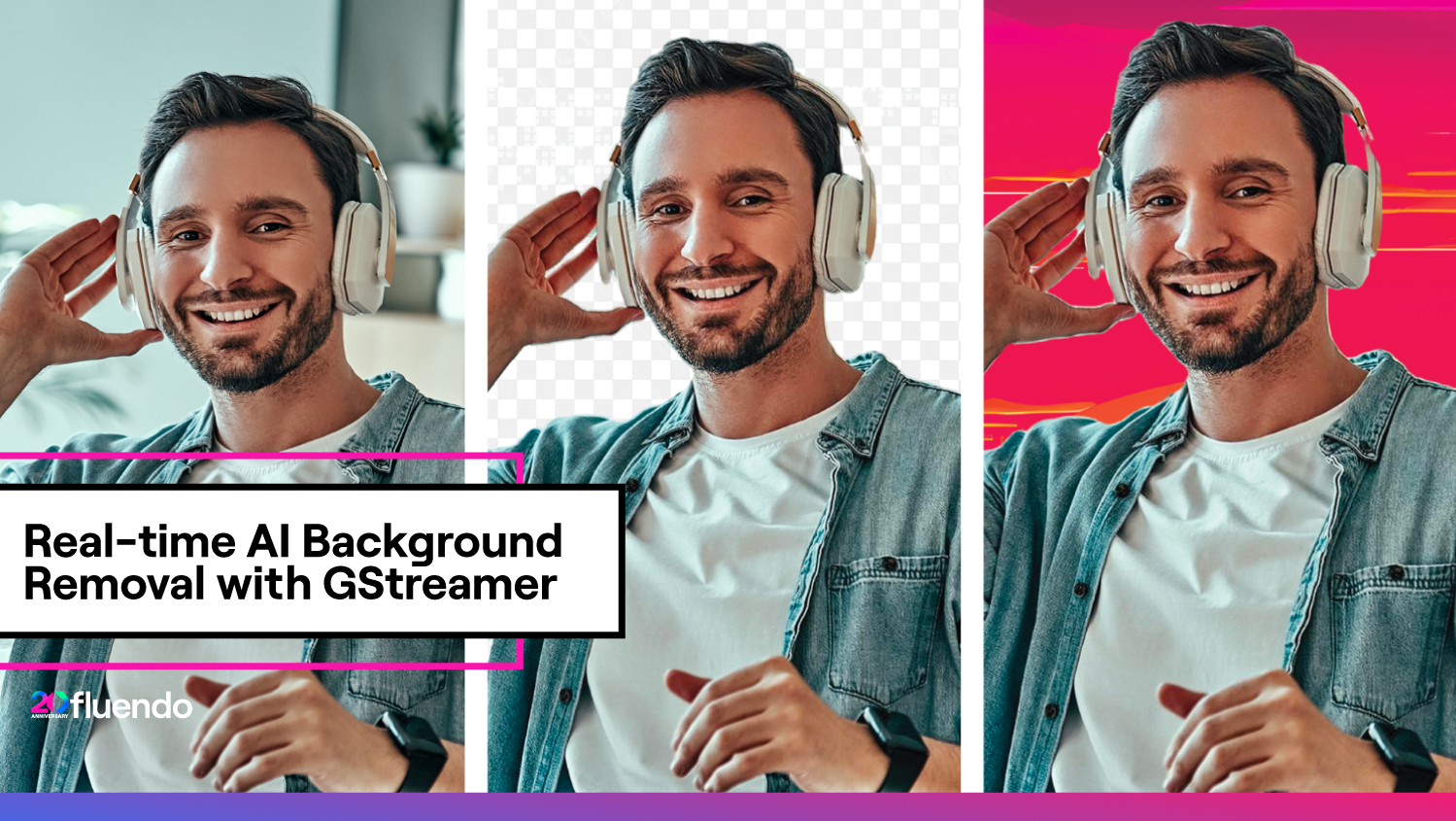
4K real-time face anonymization GStreamer plugin benchmark
broadcasting, video-surveillance, sports, education, multimedia-edge-ai, gstreamer, events, fluendo-ai-plugins, ravenProfessional real-time background removal with GStreamer and AI.
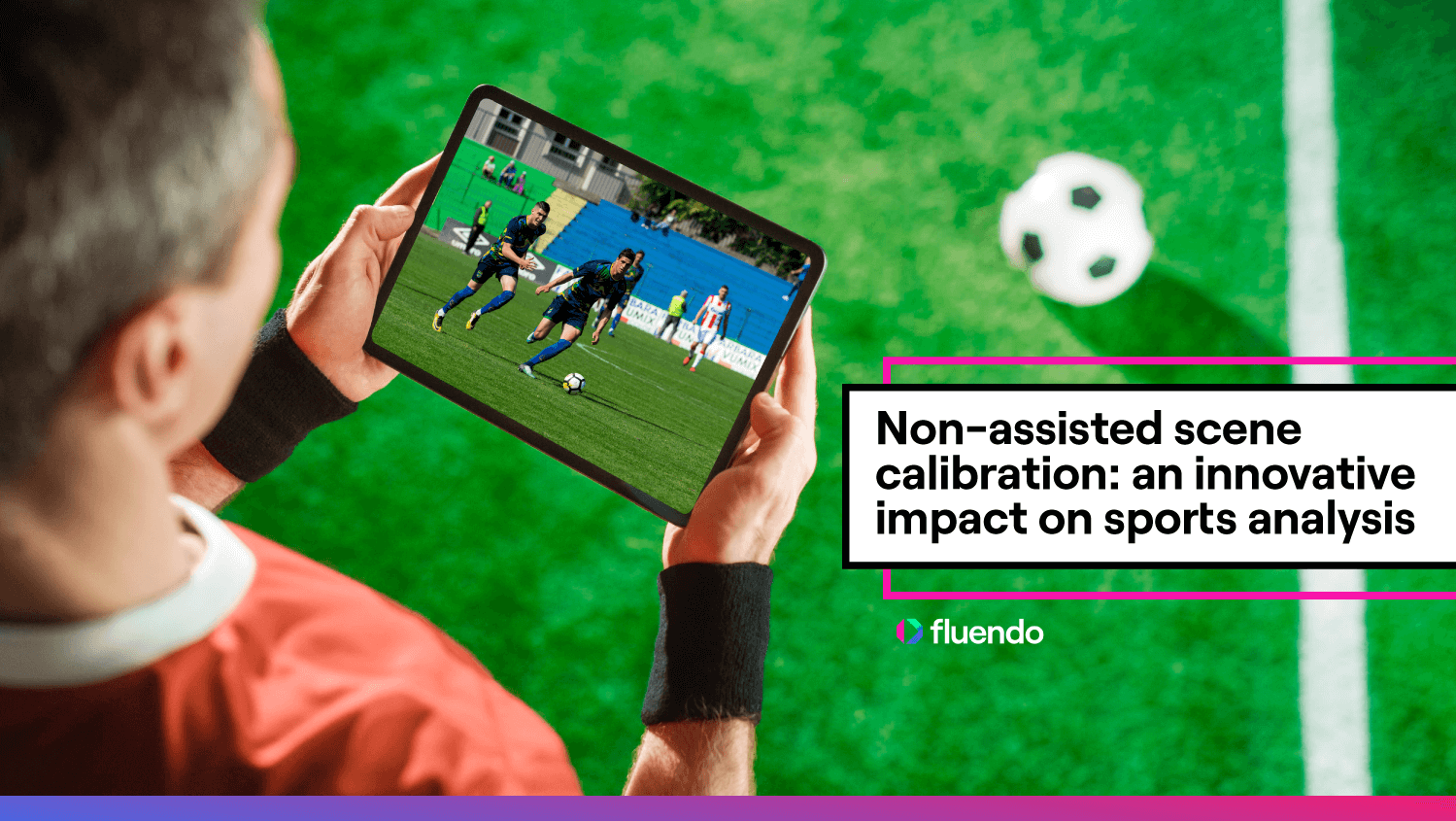
Non-assisted scene calibration: an innovative impact on sports analysis
sports, multimedia-edge-ai, ravenAutonomous scene calibration for enhanced sports video analysis.
Assisted scene calibration for sports analysis
sports, multimedia-edge-ai, ravenEvolution of sports analysis with AI and computer vision.