Fluendo awarded 6G-XR Open Call 3 grant to pioneer LCEVC-Powered holographic streaming
daas-vdi, gstreamer, codecsFluendo selected for 6G-XR grant to pioneer holographic streaming with LCEVC.

Achieve greener technology, major cost reduction, full legal compliance, and higher end user satisfaction through proven enhancements.

Fluendo brings over 15 years of focused experience in the DaaS and VDI industry. This deep history translates directly into reliable, high-performance solutions trusted across the globe. Our products have been deployed across millions of endpoints, demonstrating both scale and stability in diverse enterprise environments. Fluendo is a Citrix and Omnissa certified partner, making our products fully compatible in such environments.
Fluendo brings over 15 years of focused experience in the DaaS and VDI industry. This deep history translates directly into reliable, high-performance solutions trusted across the globe. Our products have been deployed across millions of endpoints, demonstrating both scale and stability in diverse enterprise environments. Fluendo is a Citrix and Omnissa certified partner, making our products fully compatible in such environments.
From the code to the action
Developments that bring real-world results, these case studies show how our solutions help your business achieve goals and enhance user experiences.
The recent surge in global teleworking intensified the market demand for robust DaaS & VDI solutions. A critical issue emerged from the continuous use of video conferencing applications (such as Zoom and Teams), which generated excessive bandwidth consumption, particularly when transmitting uncompressed, raw camera streams. This bandwidth bottleneck degraded the overall user experience and strained corporate networks.
To address this situation, the primary DaaS & VDI service providers implemented a feature to reduce network load by processing and compressing video directly on the endpoint before transmission.
Leading manufacturer of DaaS & VDI endpoints, such as Dell and HP, required an integrated video optimization solution compatible with existing webcam offloading features to replace raw video streams with compressed, high-quality ones. This solution must be legally compliant and highly optimized for the endpoints’ hardware capabilities. Fluendo became the ideal partner, recognized for its expertise in multimedia technologies and codec licensing.

The solution was to implement a high-performance H.264 encoder and integrate it directly into the endpoint. This encoder compresses the raw video stream into the efficient H.264 format before it is transmitted across the network.
The solution offered both a pure software encoder and a hardware-accelerated version optimized for common endpoints’ GPUs. This hardware acceleration offloaded the heavy encoding task from the CPU, freeing up critical resources on the endpoint.
Fluendo guaranteed that all H.264 codecs were fully licensed by MPEG LA, ensuring legal compliance. The solution was also built for seamless integration with existing VDI infrastructure, such as Citrix’s webcam redirection functionality, without requiring vendors to modify established protocols.
Our achievements

Achieved significant bandwidth reduction for continuous video calls in VDI environments

Optimized video encoding to leverage GPU resources, drastically reducing CPU load

Ensured H.264 licensing compliance, simplifying deployment for enterprise clients

Delivered real-time webcam video encoding directly on the thin client
Achieved significant bandwidth reduction for continuous video calls in VDI environments
Optimized video encoding to leverage GPU resources, drastically reducing CPU load
Ensured H.264 licensing compliance, simplifying deployment for enterprise clients
Delivered real-time webcam video encoding directly on the thin client

In typical Virtual Desktop Infrastructure (VDI) and Desktop as a Service (DaaS) setups, the server handles all video processing—downloading, decoding, and rendering multimedia content before encoding and streaming the recorded display to the endpoint. This process resulted in high CPU/GPU load on the server, increased network bandwidth consumption, and user-facing issues like latency and poor-quality, choppy video playback. To address this situation, the primary DaaS & VDI service providers implemented what is known as MMR (Multimedia Redirection) to offload the decoding process from the server to the endpoint.
A leading manufacturer of DaaS & VDI endpoints required us to support the standard MMR protocols found in the industry, like HTML5 multimedia redirection, Windows Media redirection, Browser content redirection, etc. This solution must be legally compliant and highly optimized for the endpoints’ hardware capabilities to efficiently decode multimedia content, with low-latency playback and minimal hardware requirements.
The implemented solution involved integrating the Fluendo Codec Pack into the operating systems of various client endpoints, including Linux, Windows, IGEL OS, and Dell Wyse ThinOS. Crucially, the Fluendo Codec Pack included hardware acceleration plugins, leveraging the client device’s GPU horsepower to substantially reduce CPU load during audio and video content processing. This move guaranteed that client devices possessed optimized and fully licensed codecs for key industry formats, such as H.264 (including patent license compliance), MPEG-4, AAC, or MP3. Leveraging Fluendo’s specialized knowledge in GStreamer and multimedia experts, the codecs were specifically tuned for low-power thin client hardware, ensuring that the local decoding and rendering process was resource-efficient and fast.
By allowing the client to download and process the raw multimedia stream locally, the solution effectively bypassed the need for the VDI server to perform intensive video processing and recoding. This architectural refinement delivered multiple benefits: a reduction of load in the server (enabling greater user density), a better quality of video/audio for the end-user (achieving fluid HD/4K playback), and full legal compliance by managing the necessary patent licensing. The integration ensured interoperability with major VDI protocol vendors, including Citrix, Omnissa, Microsoft, and others.
Our achievements

Enabled smooth HD/4K video playback on thin clients

Significantly reduced server CPU/GPU load for VDI sessions

Ensured full patent license compliance for widely used codecs

Optimized codec performance on low-power client hardware
Enabled smooth HD/4K video playback on thin clients
Significantly reduced server CPU/GPU load for VDI sessions
Ensured full patent license compliance for widely used codecs
Optimized codec performance on low-power client hardware

A major endpoint manufacturer faced a critical multimedia challenge when the browsers installed on the device were used for multimedia playback in a DaaS & VDI session, when accessing essential business tools, including SaaS platforms and collaborative applications.
Most of the browsers included on the endpoints are Chromium-based, the open-source base for popular browsers like Google Chrome and Microsoft Edge.
The main technical challenge centered on Chromium’s default multimedia limitations. Due to licensing restrictions, the pure, open-source Chromium project does not natively include proprietary codecs such as H.264 for video and AAC for audio. This exclusion prevented users from playing standard multimedia content, directly impacting the platform’s utility and user experience. Furthermore, Chromium utilizes FFmpeg as its primary multimedia framework for multimedia playback; however, this version is a Chromium-only, specific version bundled within the browser itself.
The client required a seamless, legal, and compatible solution to enable H.264 and AAC playback within their Chromium distribution and the specific FFmpeg bundled version.
Fluendo’s expertise in multimedia consulting, GStreamer, and FFmpeg integration was essential to deliver a specialized, legally-compliant, and high-performance multimedia solution for their VDI users.
Fluendo’s solution involved a dual-component strategy:
This successful integration provided a robust, legally-compliant solution that allowed VDI users of major endpoint manufacturers (such as Dell, HP, among others) to seamlessly play web content requiring H.264 and AAC, thus solving the multimedia deficiency and enhancing the user experience.
Our achievements

Delivered pre-validated FFmpeg Enabler for Chromium for immediate operational use

Enabled full, legal playback of H.264 and AAC multimedia in Chromium-based VDI environments

Achieved universal support for proprietary video and audio formats like H.264 and AAC
Delivered pre-validated FFmpeg Enabler for Chromium for immediate operational use
Enabled full, legal playback of H.264 and AAC multimedia in Chromium-based VDI environments
Achieved universal support for proprietary video and audio formats like H.264 and AAC
Concepts with real-world potential
These use cases present conceptual examples of how our ideas and technologies could address real-world industry challenges.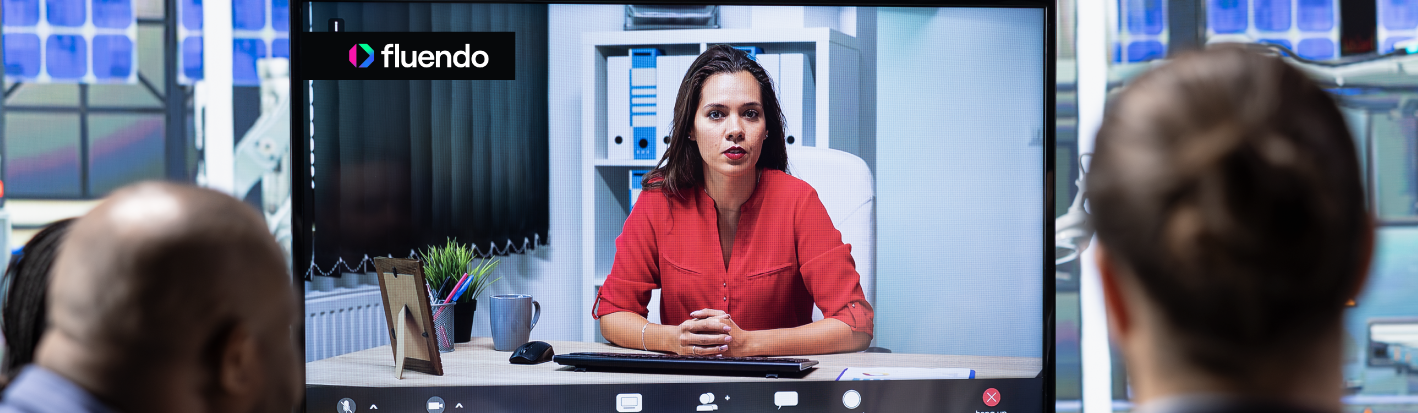
Enterprises adopting Desktop-as-a-Service (DaaS) solutions to support hybrid or remote workforces often face fragmented corporate branding during employee video conferencing.
Because employees connect from virtual desktops and diverse applications, ensuring consistent branded backgrounds across all sessions becomes difficult. This inconsistency weakens corporate identity and professional appearance in external meetings.
Fluendo’s AI-based background removal technology would be integrated into the DaaS virtual camera and communication protocol through a new concept of background removal redirection, analogous to other content redirections (such as webcam, audio or printer, etc.), enabling the processed video stream being redirected to the conferencing application featuring a standardized, corporate-branded background automatically applied.
Leveraging Fluendo’s Multimedia Edge AI technology and Raven AI engine for real-time computer vision and background segmentation, the solution would perform locally on the endpoint and would ensure optimal performance and low latency even on low-end client devices.
Our achievements

Reduce the server computing by leveraging the endpoint’s GPU to do the image processing

Seamless integration with the native OS/conferencing applications

Reinforces corporate identity, employee engagement and professional appearance
Reduce the server computing by leveraging the endpoint’s GPU to do the image processing
Seamless integration with the native OS/conferencing applications
Reinforces corporate identity, employee engagement and professional appearance

Enterprises operating DaaS & VDI environments face reduced meeting efficiency when global teams communicate across diverse accents, speech rates, and noisy environments. Standardizing speech clarity at the DaaS audio entry point would address comprehension gaps, repeat-backs, and longer call times while maintaining privacy and desktop performance, improving productivity and satisfaction.
Fluendo’s AI native-like voice enhancement toolset would operate as a virtual microphone on the user’s device, performing real-time noise suppression, voice enhancement, accent translation, and tone adjustment.
The enhanced audio stream would then be delivered into the DaaS & VDI session via standard microphone redirection (e.g., RDP/HDX/Blast), where any communication or meeting application would receive a clear, low-latency audio stream without requiring changes or additional setup.
For lower-performance or GPU-limited devices, a virtual recording component within the DaaS & VDI environment could provide the same processing capabilities server-side.
Leveraging Fluendo’s Multimedia Edge AI technology and Raven AI engine, this approach would emphasize Edge AI, real-time processing, and portability via GStreamer components to fit browser, Windows, Linux, macOS, iOS and Android endpoints.
Our achievements

Enhance communication clarity across global teams

Seamless integration with the native OS, DaaS & VDI protocols, and conferencing applications

Maintain privacy and regulatory compliance
Enhance communication clarity across global teams
Seamless integration with the native OS, DaaS & VDI protocols, and conferencing applications
Maintain privacy and regulatory compliance
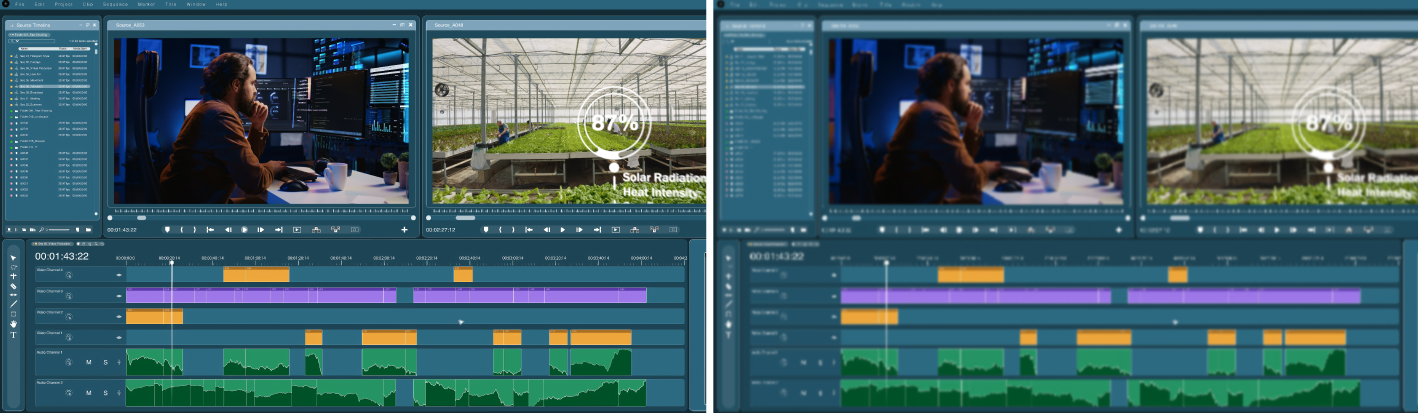
Businesses are unable to deploy graphically-intensive applications like CAD, medical imaging, or video editing via DaaS to remote workers on consumer-grade internet. Traditionally, supporting these premium use cases requires high-cost infrastructure: dedicated high-bandwidth network connections for each user and powerful, expensive server-side GPUs for real-time video encoding. This complexity makes scaling high-performance remote work financially unviable.
Fluendo’s AI-powered superresolution plugin would operate entirely on the client side to dynamically enhance video feeds, upscaling desktop content up to 4K resolution. The system would intelligently adapt to input video quality and integrate seamlessly with the DaaS protocol, native OS, browsers, and applications.
This approach would fundamentally decouple the end-user’s visual quality from network or server performance. It would remove the dependency on high-bandwidth connections and dramatically reduce the reliance on costly server-side GPU encoding, allowing businesses to deliver a premium experience over a standard internet connection.
Our achievements

Offload image enhancement to the client endpoint, increasing user density and avoiding expensive server-side GPU and network infrastructure upgrades

Artifact-free visual experience with sharp text and fine graphical detail that rivals local desktop performance

Improve remote workers’ efficiency and reduce visual fatigue

Optimized for low-end thin clients, enabling new, highly graphical, demanding remote user cases
Offload image enhancement to the client endpoint, increasing user density and avoiding expensive server-side GPU and network infrastructure upgrades
Artifact-free visual experience with sharp text and fine graphical detail that rivals local desktop performance
Improve remote workers’ efficiency and reduce visual fatigue
Optimized for low-end thin clients, enabling new, highly graphical, demanding remote user cases

DaaS & VDI administrators currently lack a reliable, non-intrusive way to measure real-time video quality perceived by users. Traditional reference-based metrics (e.g., VMAF, PSNR, SSIM) require an original source stream that is unavailable in most production desktops, making live monitoring impractical.
Subjective methods (e.g., MOS following ITU BT.500/P.910) are costly, offline, and cannot operate continuously. Meanwhile, transport-level metrics (latency, loss, jitter, bitrate) do not consistently correlate with users’ visual experience, so degradations are detected late, after productivity and satisfaction have already dropped.
An approach that estimates perceived quality without a reference and runs continuously inside real environments would close this gap.
An AI model predicts reference-free video quality metrics (VMAF-like) directly from live desktop/video streams, enabling continuous QoS visibility and proactive anomaly detection.
The capability would be provided as a modular software library and a Fluendo AI GStreamer plugin using Raven AI Engine for inference, so that it could be embedded at the endpoint, broker, or server, and exported to existing observability stacks
The model would be trained to correlate strongly with human judgments and well-known objective metrics (such as VMAF), and validated across common DaaS workloads (text editors, spreadsheets, 3D tools, conferencing) to remain content-aware and low-overhead for real-time operation.
Our achievements

Real-time visibility into user-perceived video quality

Seamless integration with existing monitoring tools. No reference video required

Automatic detection of quality degradation

Scalable and content-aware QoS measurement
Real-time visibility into user-perceived video quality
Seamless integration with existing monitoring tools. No reference video required
Automatic detection of quality degradation
Scalable and content-aware QoS measurement

Video encoders used in DaaS & VDI, even those with advanced Screen Content Coding (SCC) tools, must rely on computationally expensive intra- and inter-frame analysis of the video stream to understand the content’s complexity and motion, which consumes a significant amount of server-side CPU/GPU resources. This process is fundamentally inefficient for remote desktops because the encoder is working to deduce information that the virtualized operating system already knows intrinsically. This redundancy creates a direct and costly trade-off between visual quality and server density.
Our solution, built specifically for the remote desktop environment, will tap directly into the virtualized operating system’s window management APIs to understand the desktop composition in real-time. It will identify window boundaries, classify content type (text, graphics, video), and track motion vectors as they occur.
This rich contextual information will then be fed directly to our RDCT video codec and AI-based enhancements. This will allow them to bypass much of their own costly analysis and instantly apply the perfect quality and compression level to each region, dedicating maximum resources to critical areas while conserving them on static parts of the screen.
Our achievements

Reduce the server computing OpEx and increase user density per server by enhancing only where/when is needed

Superior visual fidelity for desktop-specific content

Integration without any changes to your existing DaaS & VDI stack

High-performance remote work financially viable at scale
Reduce the server computing OpEx and increase user density per server by enhancing only where/when is needed
Superior visual fidelity for desktop-specific content
Integration without any changes to your existing DaaS & VDI stack
High-performance remote work financially viable at scale

Enabling local media playback and multimedia redirection for IGEL Thin Clients was our main objective, and we were looking for a solution that would allow us to provide business clients access to server-based computing and virtual desktops. To satisfy our codec needs, the Major Virtualization vendors recommended Fluendo as a provider of the required codecs, so we contacted them to learn about their GStreamer codec plugins. The provided Fluendo codecs could be integrated into our development without any problem. Thanks to Fluendo, IGEL can offer its clients a full PC-like experience.

Fluendo’s in-depth knowledge of the video decoding process and the GStreamer framework has enabled HP to deliver a premium user experience across our range of embedded devices. Their engineer-to-engineer discussions with AMD were key to identifying ways that HP’s ThinPro embedded Linux operating system could exercise more GPU functionality.
Bits & Bytes
Explore our blog, one byte at a time. Our team unpack our latest news, industry insights and in-depth articles to connect you with the multimedia world.Fluendo selected for 6G-XR grant to pioneer holographic streaming with LCEVC.
Fluendo selected for SPIRIT grant to develop AI-powered avatar telepresence.
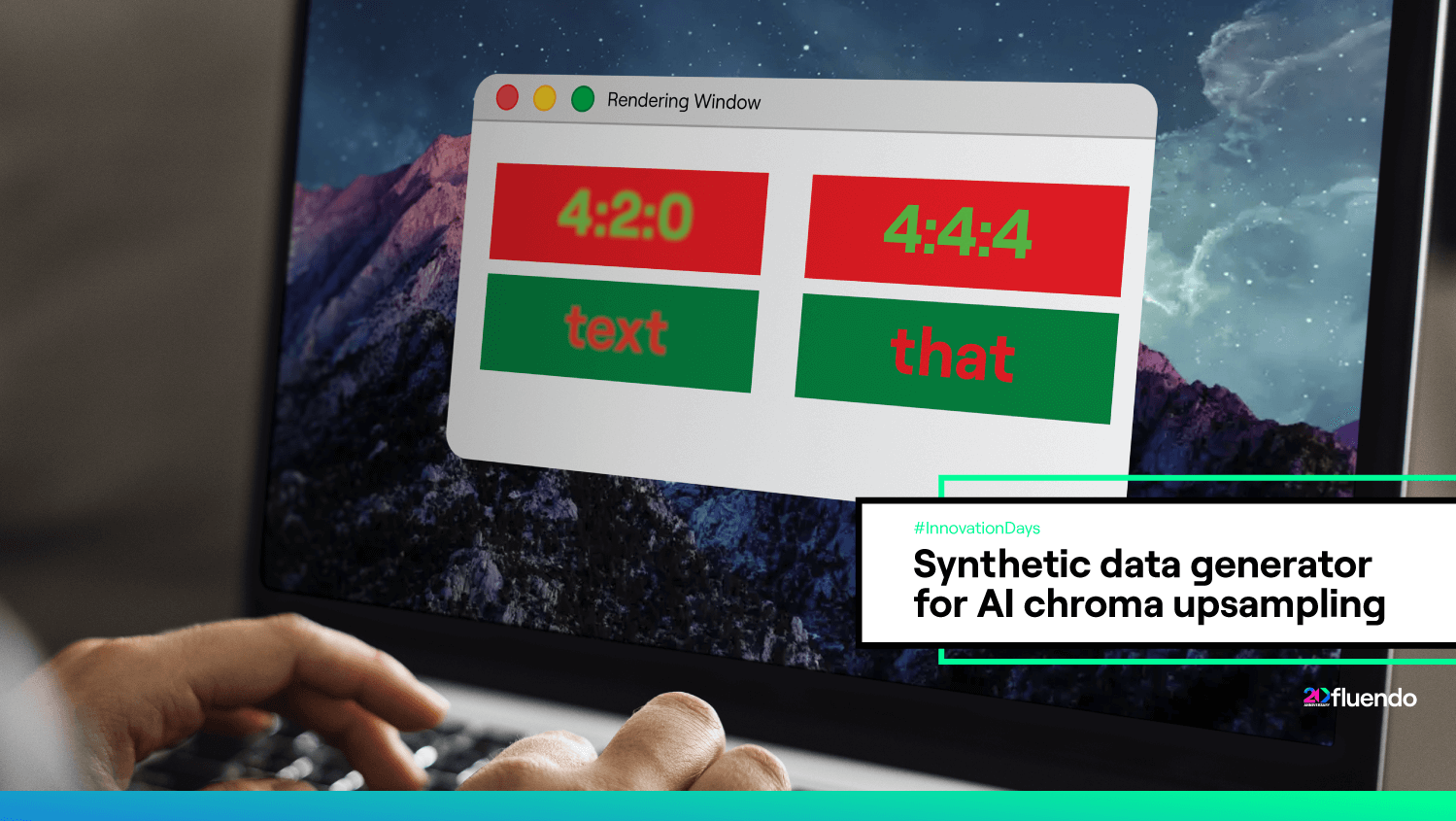
Enhancing DaaS image sharpness with AI-driven chroma upsampling.
Enhancing FreeRDP performance with MPEG-5 LCEVC for DaaS and VDI.