
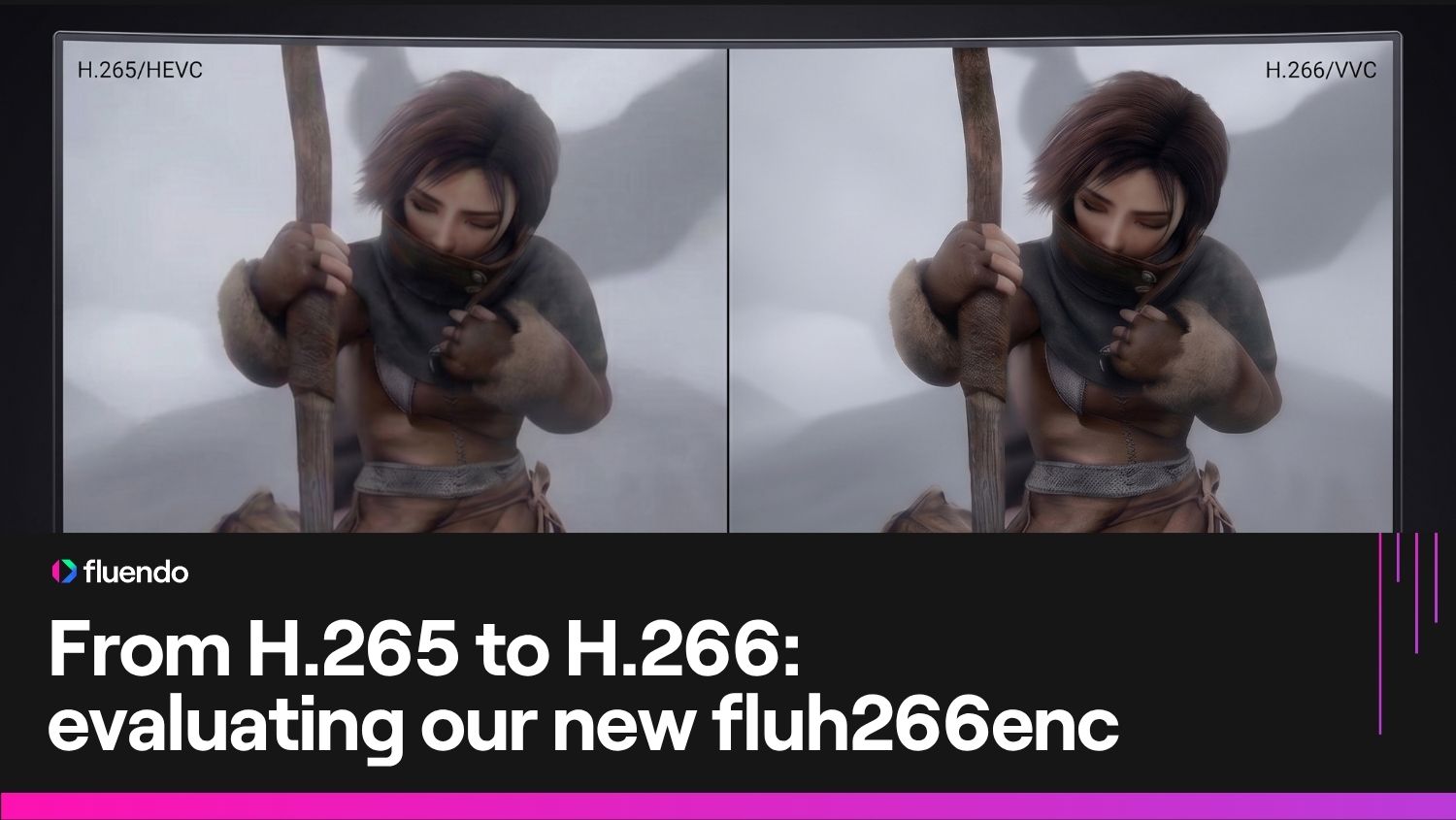
From H.265 to H.266: evaluating our new fluh266enc

Written by
FluendoJune 25, 2026
At Fluendo, we have been working with VVC/H.266 encoding as part of our STREAM – Scalable Telepresence with Real-time EnhAnced Multimedia project, one of the winners of the SPIRIT - Scalable Platform for Innovations on Real-time Immersive Telepresence Open Call 1.
Building on what we previously shared in our engineering update, we recently
released fluh266enc and fluh266dec, our new GStreamer elements for H.266
software encoding and decoding, based on the state-of-the-art Fraunhofer
open-source library (vvenc)
In this blog post we’re going to compare our H.266 encoder, fluh266enc, with
the reference H.265 software encoder, x265enc, to
evaluate the quality achieved at same levels of compression. For measuring
visual quality, we chose VMAF, and we
mapped the compression performance of both codecs using a standard
rate-distortion graph.
Our dataset consisted of several videos with varying content types, including natural real-world recordings typically seen in movies, as well as desktop screen-casts representing diverse remote collaboration scenarios.
Rate distortion
In this evaluation, we plotted the requested target bitrate against the resulting visual quality (VMAF) to evaluate compression efficiency.
Average rate distortion
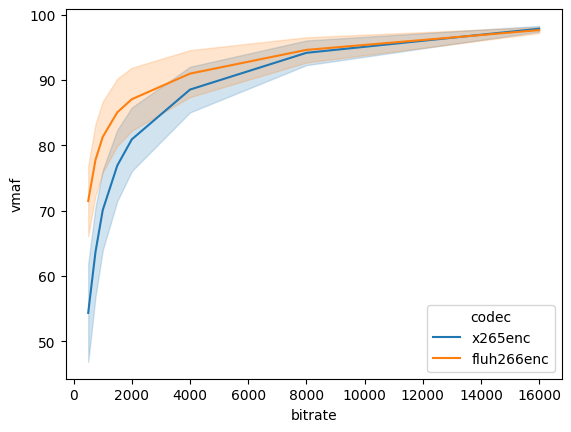
The metrics showed that, on average, fluh266enc produced significantly higher
visual quality than x265enc for the same requested bitrate. Viewed the other
way around, fluh266enc uses substantially less bandwidth without compromising
the quality.
Rate distortion per preset
When choosing an encoder profile or preset, we selected specific configuration parameters that determined the speed-to-compression ratio. A fast preset prioritized processing speed with lower compression, whereas a slow preset maximized compression efficiency at the cost of processing time.
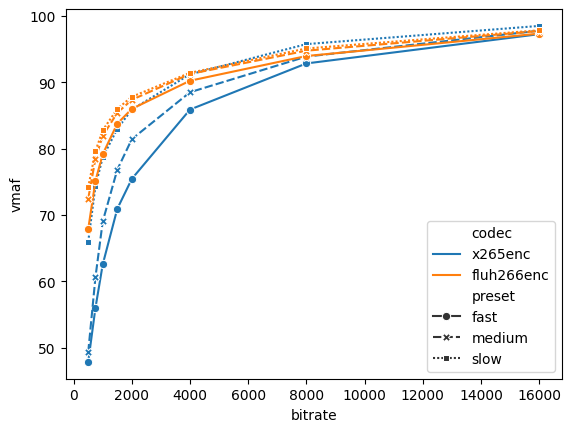
Our benchmarking revealed that x265 required its slowest, most computationally
intensive profile to match the raw performance and quality that we achieved
using the fastest configuration profile of fluh266enc.
Example
To visualize these data points in a practical scenario, we extracted and
evaluated identical individual frames. Below is a direct visual comparison
between two frames from the open-source movie Sintel, both encoded at a
restricted target bitrate of 500 kbps using a standard “medium” preset with
fluh266enc and x265enc.
fluh266enc (H.266) | x265enc (H.265) |
|---|---|
 |  |
As observed in the side-by-side comparison, the frame encoded with fluh266enc
achieved significantly higher visual fidelity, successfully preserving fine
details and reducing compression artifacts that were visible in the x265enc
output at the same bitrate constraint.
Conclusions
The collected data demonstrates that our new fluh266enc software encoder
delivers a superior compression-to-quality ratio compared to H.265. Across our
entire testing dataset, the H.266 pipeline achieved identical objective visual
quality scores while demanding significantly less bitrate, yielding substantial
bandwidth savings without sacrificing video fidelity.
Curious how fluh266enc can benefit your workflow or have questions about
integrating our H.266 solutions?
Get in touch with us through here. We’re excited to connect!