
Fluendo at the Core of GStreamer 1.28.0: Leadership in ORC and video quality measure with VMAF

Written by
Ruben GonzalezFebruary 17, 2026
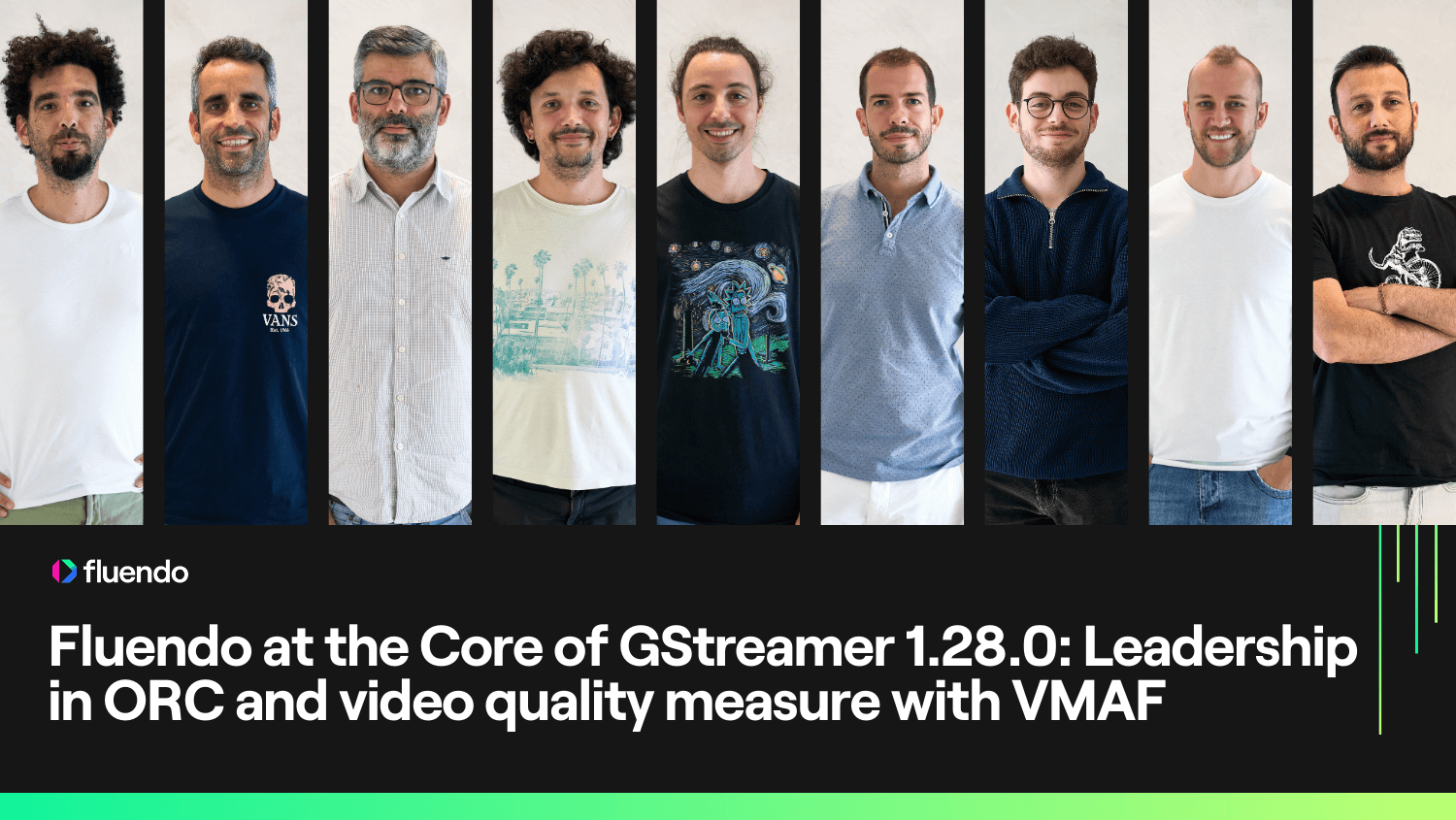
The GStreamer 1.28.0 major feature release is officially here, and the Fluendo team has been right at the heart of it. This cycle, 10 Flunions stepped up as core contributors—Alexander Slobodeniuk, Andoni Morales, Carlos Falgueras, Diego Nieto, Jorge Zapata, Manuel Torres, Marek Olejnik, Pablo García, Ruben Gonzalez, and Ruben Sanchez—maintaining the high activity levels seen in version 1.26.0 but with an even stronger focus on high-impact, qualitative improvements.
A big win for ORC: Jorge Zapata named ORC Ccommitter
Before diving into the code, we have some fantastic news: our own Jorge Zapata has been granted committer status in the Oil Runtime Compiler (ORC) subproject. This recognition highlights Fluendo’s leadership in low-level performance optimization and ensures we continue to drive the future of SIMD acceleration.
Why does this matter? In high-end video processing, speed is everything. ORC is the “engine under the hood” of GStreamer that translates complex math into SIMD (Single Instruction, Multiple Data) instructions. This allows a CPU to process multiple pixels simultaneously rather than one at a time, which is the difference between a laggy stream and a seamless 4K experience.
By having a seat at the table as an ORC Committer, Fluendo doesn’t just use this technology: we help build it. This recognition highlights our leadership in low-level performance optimization and ensures we continue to drive the future of hardware acceleration, making GStreamer faster and more efficient for everyone.
1. perceptual quality with the new vmaf Element
We’ve introduced the vmaf element, a powerful tool designed to calculate video quality scores using Netflix’s VMAF framework.
Human-centric metrics: Unlike traditional math-based checks, VMAF uses machine learning to predict how a human viewer would perceive video quality.
The strategy: This is part of our broader effort to improve encoder quality. By measuring perceptual scores, we can fine-tune our tools to deliver the best possible visual experience.
Future-proof: This approach sets the stage for a new series of OSS tools and plugins currently in our pipeline.
We’re working on a blog post about this with example pipelines. Stay tuned.
2. Cerbero & gst.wasm: Streamlining the Build
Efficiency begins with the build process. We have modernized Cerbero, the build system used for GStreamer binaries and our gst.wasm project.
Architecture upgrade: We replaced the legacy
use_system_libsflag with a more flexible SystemRecipes system.Easier onboarding: You can now install the environment via pip, making it significantly faster for developers to get
gst.wasmup and running.
3. Orc & AVX512: Supercharging speed
Our long-term commitment to the ORC project continues to yield massive performance gains for the community.
Modern hardware support: We’ve landed support for the AVX512 instruction set, allowing GStreamer to leverage the full power of the latest CPUs.
Better documentation: We’ve added new documentation and completed several refactors to make the project more accessible and maintainable for the community.
4. General fixes and stability
Stability is the backbone of any great framework. Fluendo provided numerous fixes and improvements for this release.
What’s next? The road to 1.30
We aren’t slowing down. Looking ahead to GStreamer 1.30, Fluendo will continue to push the framework forward with new features like Digitally Signed Content (DSC) support. This initiative will enhance security and integrity verification for multimedia streams, ensuring that your content remains authentic from source to screen.
Want to see how these improvements can power your next project? Contact us to learn more about our GStreamer consulting and AI services.